A late payment collection system exists for one reason: because chasing clients by memory doesn’t scale. It’s easy to build a story around a late invoice—the client is disorganized, the client doesn’t respect your time, the client is being difficult. You send a follow-up message, feel a little awkward doing it, and wonder if this is just what running a service business looks like now.
Look closer at the pattern, though, and the story falls apart. Lateness rarely comes from one client. It shows up across several, on unrelated projects, all going quiet around the same due date. That’s not a coincidence of character—it’s a signal. When lateness spreads across clients who have nothing in common, the common denominator isn’t them. It’s the process the invoice traveled through to reach them.
What actually causes a late payment
Most overdue invoices don’t happen because a client decided not to pay. An invoice that never had a real chance of being paid on time causes them. A few quiet failure points do almost all the damage:
- The invoice arrived without urgency. One email lands in a crowded inbox, competing with everything else your client is juggling—no second touch, no reminder, no reason to act today instead of “later.”
- Nobody tracked it. When invoices live across email threads, a spreadsheet, and a banking app, no single view shows what’s actually overdue right now. You discover a late payment only when you go looking for it—usually weeks after it should have arrived.
- Follow-up depended on memory. Manual chasing only works if you have the time and the memory to do it consistently, for every client, every month. That’s not a discipline problem; it’s an unreasonable ask of any single person running a business.
None of this is about your client’s intentions. It comes down to whether your process created a clear, trackable, repeated nudge toward payment—or just hoped for the best.
Why a late payment collection system beats “chasing harder”
The instinctive response is to try harder: send more follow-ups, check email more often, stay on top of it personally. This works for a while. Then your client list grows, and the same manual process that barely held together starts cracking everywhere. You’re not collecting payments faster—you’re spending more hours doing the same fragile thing.
A proper late payment collection system removes the memory requirement entirely. The reminder goes out automatically, on schedule, whether or not you remembered it existed. Every invoice’s status—sent, viewed, due, overdue—lives in one place you can check in seconds, instead of getting reconstructed from inbox searches. According to Investopedia’s explainer on days sales outstanding, the metric exists specifically because businesses that can’t measure how long they wait to get paid can’t fix it either—tracking is the first step, not an afterthought.
How Bill Monitor works as your late payment collection system
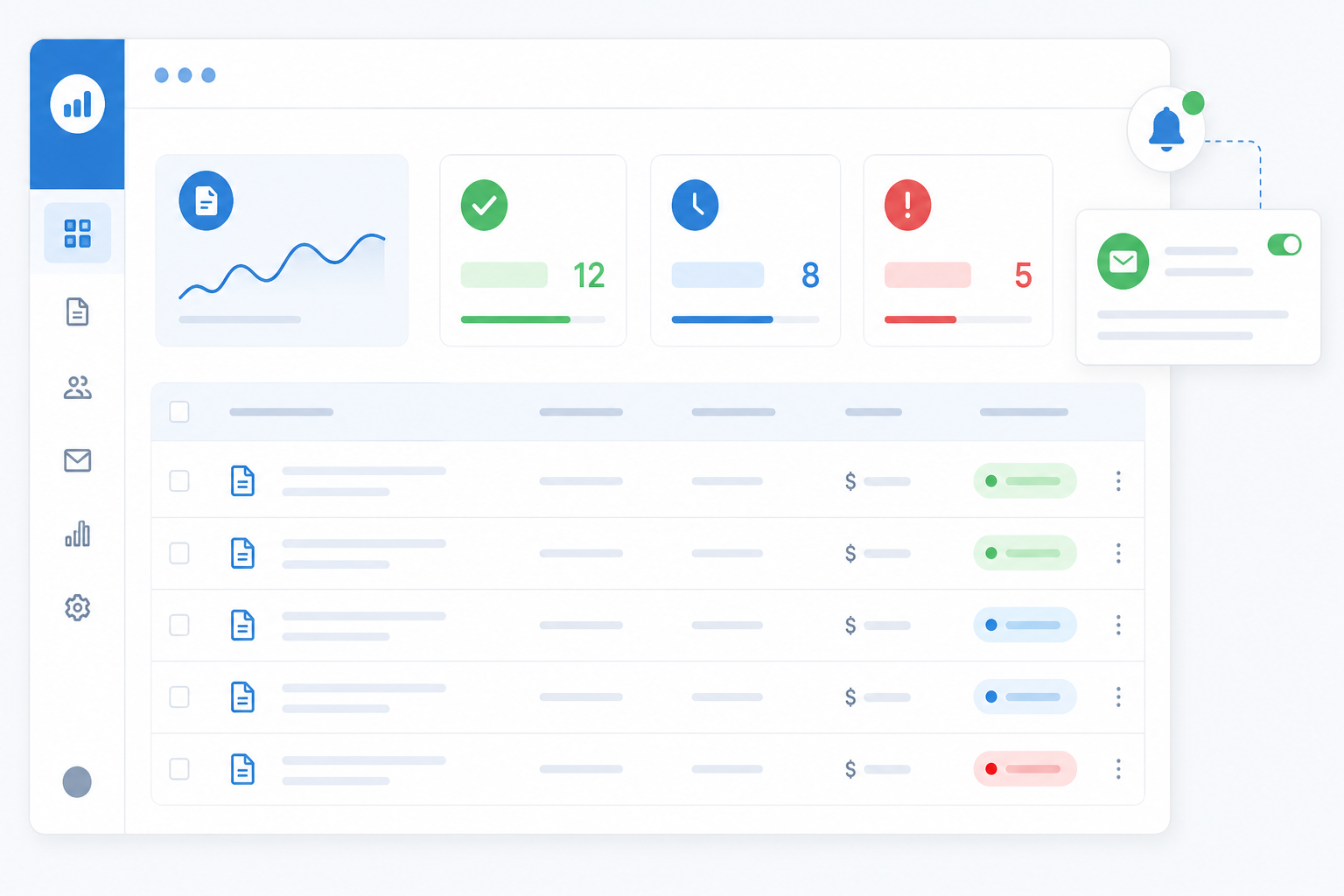
This is the exact gap Bill Monitor closes. One dashboard shows every invoice and its real payment status, so nothing gets pieced together from email, banking apps, and spreadsheets that don’t talk to each other. Reminders send automatically on the schedule you set, so a late invoice gets a nudge whether or not you remembered to send one yourself. Clients get notified without you playing messenger, and you get paid faster without losing your week to chasing.
Explore Bill Monitor’s plans to see which setup fits your client volume, or check the full feature list for everything the dashboard tracks beyond reminders.
The relationship stays a relationship. A system, not an awkward conversation you keep having to start, becomes responsible for the reminder.
The real payoff of switching systems
For most service businesses, recovering just one late payment a month covers the cost of running a proper system. Everything after that is time back, fewer uncomfortable follow-ups, and a clearer picture of what’s actually owed to you. That’s what happens when a late payment collection system—not the person running the business—does the work of getting you paid on time.